

Arabica vs robusta: what is the difference, which to choose?
Published on 01/11/2026, 9 min read
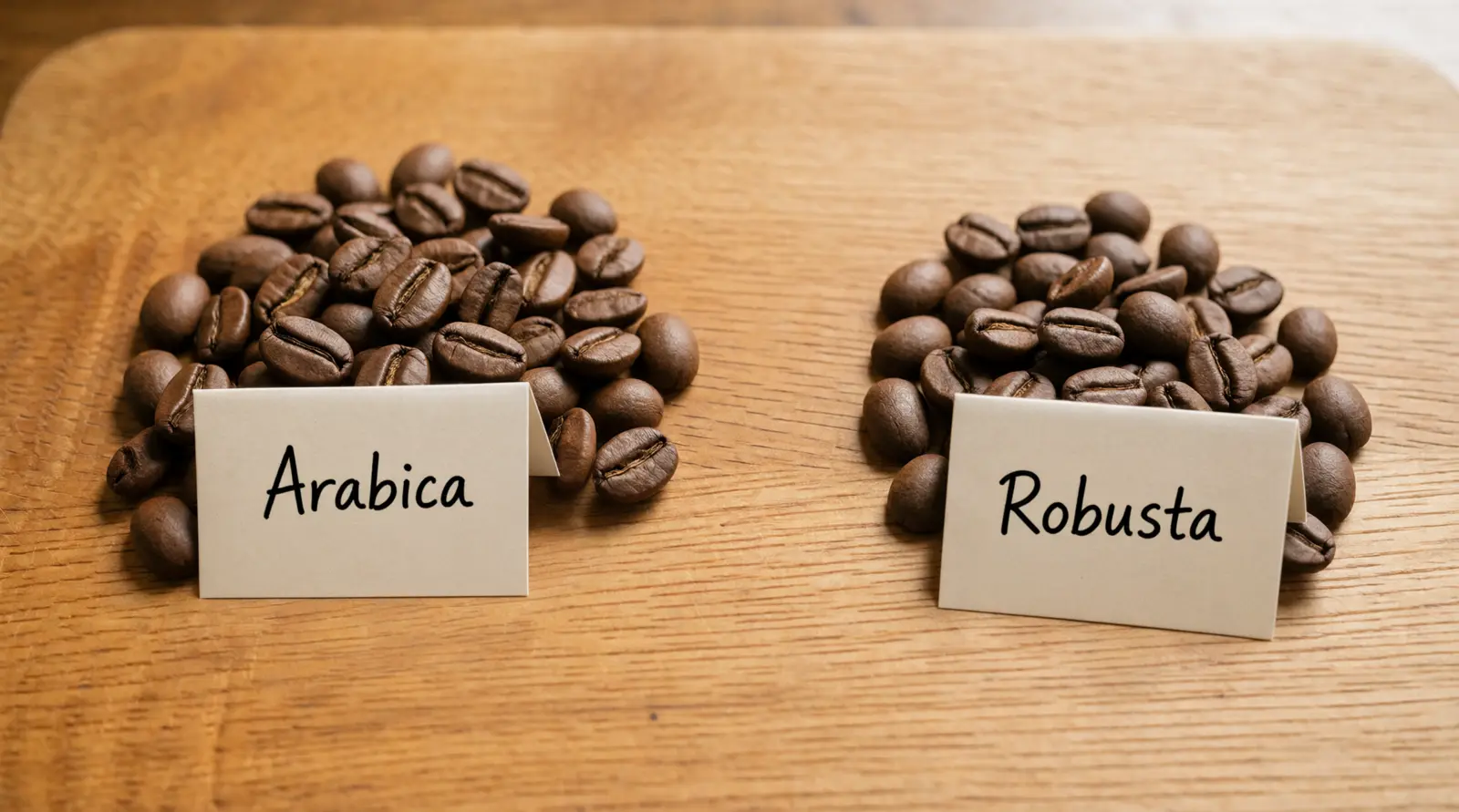
Arabica vs robusta: two words that keep coming up on coffee bags. You often hear that arabica is the good coffee and robusta the bad one. The reality is more interesting. They are two different species, each with its own taste, chemistry and uses. Here is the difference between arabica and robusta, and how to choose based on what you enjoy in the cup.
In short: the differences at a glance
- Taste: arabica is softer, brighter and more aromatic. Robusta is more bitter and stronger, with woody or cocoa notes.
- Caffeine: about 1 to 1.5 % for arabica, about 1.5 to 2.5 % for robusta. Usually 1.5 to 2 times more.
- Bean: oval with an S-shaped crease for arabica, smaller and round with a straight crease for robusta.
- Growing: arabica grows high up, where it is cool. Robusta grows lower, in the heat.
- Production: just over half of the world's coffee is arabica, about 45 % robusta.
- Price: robusta is usually much cheaper.
- Espresso: robusta adds body and bitterness. Its effect on crema is less clear than people often say.
Two species of coffee plant, not two varieties
Arabica and robusta are neither brands nor varieties. They are two botanical species of the genus Coffea. Arabica is called Coffea arabica. Robusta is the common name for Coffea canephora, of which it is the most widely grown form.
Arabica comes from the highland forests of Ethiopia. It is a natural hybrid, born a very long time ago from a cross between Coffea canephora and another species, Coffea eugenioides. It has four sets of chromosomes instead of two, so 44 instead of 22. It self-pollinates: each plant can reproduce on its own.
Robusta comes from the lowland forests of Central Africa, around the Congo basin. It does not self-pollinate: its flowers need pollen from another, compatible plant. This creates more genetic diversity from one tree to the next.
Where and how they grow
Arabica likes it cool. It is most often grown above 1,000 metres. Its ideal average temperature is around 18 to 21 °C over the year. At altitude, the cherries ripen more slowly. The bean has more time to build up sugars and other flavour compounds. In Brazil, the largest producer, arabica grows mainly on wide plateaus and rolling hills, not on mountain slopes.
It is a fragile plant. It suffers from heat, frost and above all coffee leaf rust, a fungus that attacks the leaves. Its yield is also lower.
Robusta lives up to its name. It grows from sea level to about 800 metres, in hot and humid regions. Sources put its ideal temperature at around 22 to 30 °C, but recent research shows that it also suffers from heat. It resists some diseases better, such as coffee leaf rust. It also yields more coffee per hectare.
The big arabica countries are Brazil, Colombia, Ethiopia and Central America. Robusta comes mainly from Vietnam, the world's largest producer, from Brazil (where it is called conilon), Indonesia, Uganda and India.
In volume, arabica makes up just over half of world production: about 53 to 56 % according to USDA figures for 2025/26 and 2026/27. Robusta makes up about 44 to 47 %. Its share has been rising for years: it was about 28 % in the early 1990s. Vietnam accounts for much of this growth.
Telling the beans apart by eye
Put a few beans of each on a table. You will see the difference quickly, even after roasting.
- Arabica: larger bean, oval and slightly flat. The central crease forms a wavy line, shaped like an S.
- Robusta: smaller bean, rounder and more domed. The crease is almost straight.
Size also depends on the variety and on sorting. These clues are useful, but they are not a hard rule.
What is inside the bean: sugars, oils, acids and caffeine
The taste of coffee comes from the chemistry of the green bean, transformed by roasting. On this point, the two species are very different. The figures below are for green beans. They vary with origin, harvest and measuring method.
Caffeine
Arabica contains about 1 to 1.5 % caffeine. Robusta contains about 1.5 to 2.5 %, usually 1.5 to 2 times more. Caffeine is bitter, but it explains only a small part of coffee's bitterness.
Sugars
Arabica contains much more sucrose, often around 6 to 9 %. Robusta usually contains less, with wide differences between studies. During roasting, these sugars caramelise and give notes of caramel, fruit or honey. This is one reason why arabica tastes sweeter.
Lipids
Arabica is also richer in oils: about 15 % on average, against about 10 % for robusta. Some of these oils end up in the cup, especially in espresso.
Chlorogenic acids
Robusta contains more chlorogenic acids: about 7 to 14 %, against about 4 to 8 % for arabica. During roasting, they partly break down into bitter compounds. They also bring astringency. They contribute to robusta's harsher taste.
The difference in the cup
A good arabica offers a wide range of flavours. Depending on its origin, you will find fruit, flowers, caramel, hazelnut or chocolate. Its acidity is more noticeable. It is not sour: it brings liveliness, as in a piece of fruit.
Robusta is more direct. It has more body, more bitterness, and woody, earthy, cereal or bitter cocoa notes. Its acidity is low. In the mouth, it feels thicker and longer.
Is robusta bad coffee?
Robusta has a bad reputation, and it comes from somewhere. A large part of the world's robusta is produced in large volumes and at low prices. Much of it goes into instant coffee and cheap coffee, often flat and very bitter.
But that is a matter of farming and processing, not of species. A robusta picked ripe, sorted and washed is a different thing altogether. These are called fine robustas. Their taste is cleaner, less harsh, with notes of cocoa, nuts or spices. There is even a dedicated grading system for fine robustas, just like for specialty arabicas.
India, for example, is known for its washed robustas. Washing means removing the fruit pulp before drying. The cup is then cleaner.
On the other hand, a mediocre arabica, poorly sorted or too old, will not taste good either. The words “100 % arabica” on a bag are not a guarantee of quality. They tell you the species.
Why Italian espresso contains robusta
In Italy, many espresso blends contain some robusta. The share varies a lot from one blend to another, from a few percent to more than half. It is not only about price.
- Crema: many roasters rely on robusta for crema. Studies are more nuanced: crema also depends a lot on freshness, roast and extraction.
- Body: it adds density in the mouth, especially in a short espresso.
- Milk: its strength comes through the milk of a cappuccino or latte better.
- Balance: a small share of robusta softens the acidity of an arabica blend.
The dose matters. A little robusta gives structure. Too much robusta drowns the aromas of the arabica.
Price: why robusta costs less
On world markets, robusta usually sells for much less than arabica. It yields more per hectare and resists some diseases better. The gap changes from one harvest to the next, but robusta usually remains the cheaper of the two.
How to choose for your taste and your method
- You like soft, fruity or floral coffees: choose a 100 % arabica.
- You like strong coffees, low in acidity, with some bitterness: a blend with robusta will suit you.
- You make espresso and like a strong coffee with body: a blend with some robusta is a good choice.
- You make filter coffee (V60, Chemex, drip machine): arabica shows its fine aromas better with these gentle methods.
- You use a moka pot: both work. Robusta makes a stronger coffee, arabica a more aromatic one.
- You are sensitive to caffeine: choose 100 % arabica, which contains much less.
Our coffees on this scale
At Braza, our whole-bean coffees cover the whole range, from a blend with robusta to a pure single-origin arabica.
King: 80 % arabica, 20 % robusta
King combines arabicas from Brazil, Ethiopia, Colombia and Guatemala with 20 % washed robusta from India. It is full-bodied, long on the palate and low in acidity. The robusta gives it body. It also suits filter coffee and the moka pot. In the cup: floral notes, forest fruits and a honeyed finish.
Queen: 100 % arabica
Queen is a blend of arabicas from Brazil, Ethiopia, Colombia, Guatemala and India. Good body, long on the palate, marked acidity. It is lively, with notes of caramel, forest fruit jam, biscuit and hazelnut. It suits all brewing methods.
Ace: single origin, 100 % arabica from Brazil
Ace comes from a single region, the Cerrado, in Brazil. Medium body, low acidity, long on the palate. It is soft and round, with notes of cocoa and cereal. Proof that a pure arabica is not necessarily bright and acidic.
Not sure? The discovery pack contains one bag of each. It is the easiest way to compare arabica and robusta at home.
Frequently asked questions
Which one has more caffeine?
Robusta. It contains about 1.5 to 2.5 % caffeine, against about 1 to 1.5 % for arabica. That is usually 1.5 to 2 times more.
Is robusta lower quality?
Not necessarily. Many cheap robustas are mediocre. But fine robustas, picked ripe and washed, make clean and pleasant coffees. Quality depends on farming and processing, not only on the species.
Does robusta give more crema?
Not necessarily. Crema depends mainly on how fresh the coffee is, the roast and the machine settings. Arabica and robusta both produce it. A pure robusta crema tends to be dark brown, with grey tones. A pure arabica crema leans more towards reddish brown.
What does “100 % arabica” on a bag mean?
That the coffee contains only the species Coffea arabica. It tells you the species, not the freshness or the quality. Also look at the origin and the roast date.