

Coffee to water ratio: how much coffee per cup, by method
Published on 03/11/2026, 8 min read
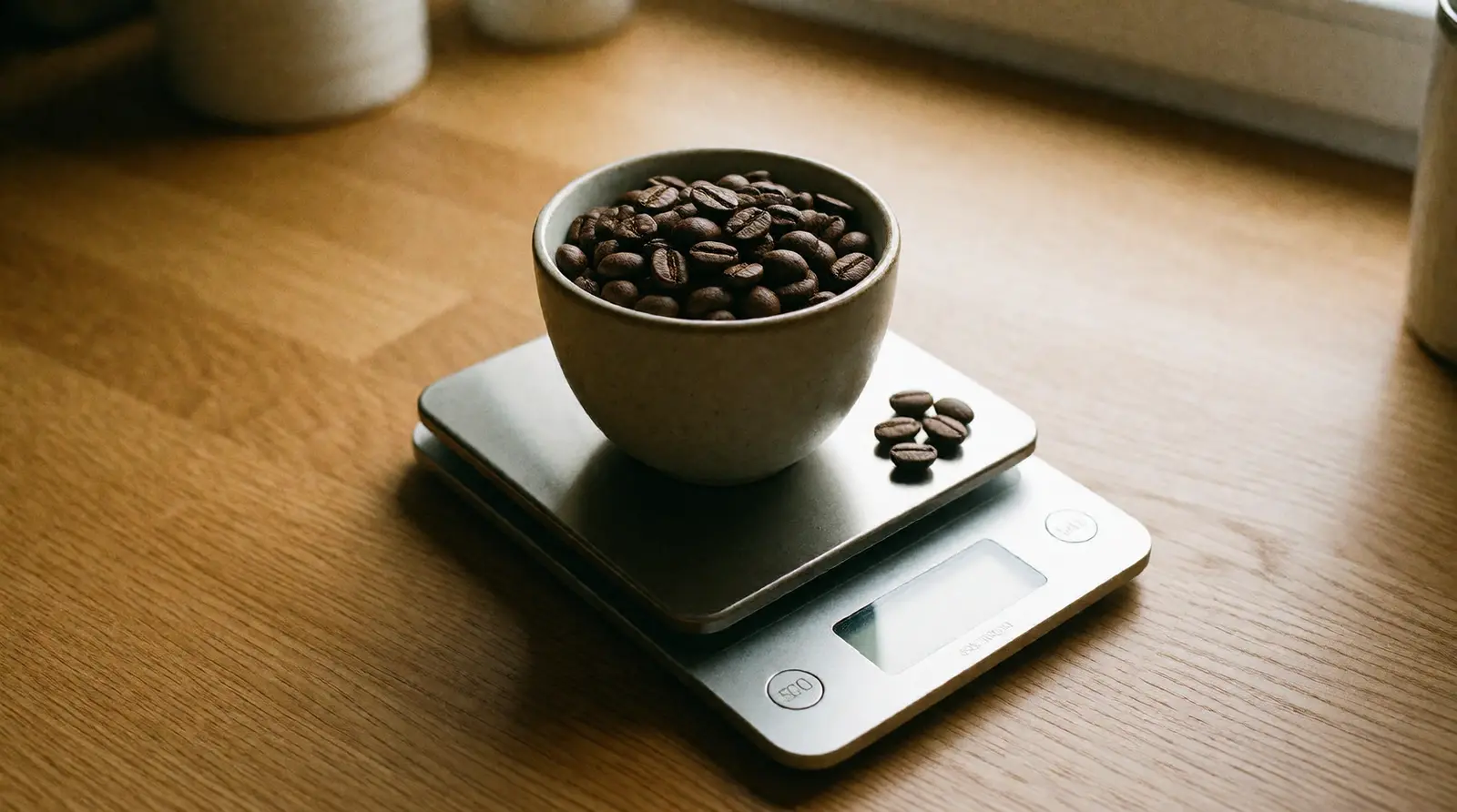
The coffee to water ratio comes down to two numbers: the weight of the coffee and the weight of the water. A scale that reads to the gram is enough. This guide gives how much coffee per cup and how much water for each method, what a 250 g bag yields, and how to adjust to your taste.
Why weigh rather than count spoons
A spoon measures volume. But the same volume of coffee does not always weigh the same.
One study of finely ground arabica measured a bulk density of 0.39 g/cm³ for a light roast and 0.28 g/cm³ for a dark roast. So the same spoon can hold over a third more coffee depending on the roast. And that is not all: a level spoon and a heaped spoon are very different amounts.
A scale solves the problem. The National Coffee Association also recommends a digital scale for measuring coffee and water.
Weigh the water too
At room temperature, 1 ml of water weighs about 1 g. Boiling water is slightly less dense: 250 ml then weighs about 240 g. The gap is small, but a scale removes it.
For espresso, weight is even more useful. The volume in the cup includes the foam, while the weight depends only on what flows into the cup.
The coffee to water ratio, explained simply
A ratio of 1:16 means 1 g of coffee for 16 g of water. The larger the second number, the lighter the coffee.
Here is an example. You want to brew at 1:16 with 320 g of water. Divide the weight of the water by 16: 320 ÷ 16 = 20 g of coffee. The other way round, 20 g of coffee × 16 = 320 g of water.
Not all of that water reaches the cup. In filter brewing, the grounds hold on to about 2 g of water per gram of coffee. Your 20 g therefore keep about 40 g, which leaves about 280 g of drink.
Which ratio should you choose? The Golden Cup standard of the Specialty Coffee Association sets 55 g of coffee per litre of water, plus or minus 10%. That is about 1:18, with a margin from about 1:16.5 to 1:20. For hand-poured filter coffee, the National Coffee Association gives 1:13 to 1:16 instead. These benchmarks do not say the same thing, and that is normal: they are starting points, and your taste decides.
How much coffee for each method
Here is a starting point for each method. The amounts are then easy to work out for one cup or several.
Espresso
For a single, allow 7 to 9 g of coffee. The rules of the Espresso Italiano Certificato set 7 g for about 25 ml in the cup, foam included, in about 25 seconds. For a double, 16 to 18 g is common.
The most widely used ratio is 1:2: 18 g of coffee for about 36 g of espresso in the cup, in 20 to 30 seconds. Here, a scale accurate to 0.1 g is a real help.
Moka pot
Here, the pot sets the dose. Bialetti asks you to pour room-temperature water up to the level of the safety valve, without going past it. Then fill the filter to the brim, without forming a mound and without tamping.
For a 3-cup moka pot, that means about 14 to 18 g of coffee depending on the model and about 150 g of water, for about 130 ml of coffee. The ratio is around 1:10. Note that these cups are small: about 40 to 60 ml each.
Drip coffee machine
Allow 55 to 60 g of coffee per litre of water. That gives about 14 to 15 g for 250 g of water, 28 to 30 g for 500 g of water, and 55 to 60 g for 1 litre.
Think in grams or litres rather than cups, because a cup has no standard size. Weigh the water before pouring it into the tank.
V60 and hand filter
Hario suggests 15 g of coffee for 250 ml of water, which is one large mug and a ratio of about 1:17. For two mugs, double both: 30 g and 500 ml. The coffee should finish draining in about 2 minutes 30.
For a fuller cup, the National Coffee Association range gives about 16 to 19 g for 250 g of water. Start by wetting the coffee with twice its weight in water, so 30 g for 15 g, then wait 30 to 45 seconds before continuing.
French press
The National Coffee Association gives 1:10 to 1:16 and about 4 minutes of contact. A good starting point is 1:15: 20 g of coffee for 300 g of water, 33 g for 500 g, 67 g for 1 litre.
Since the coffee sits in the water, it holds on to slightly more than in a filter. So you get a little less drink than the water you poured.
AeroPress
The official instructions call for one heaping AeroPress scoop, or 16 to 18 g of coffee, and water at 85 °C up to mark 4. Stir for about 3 seconds, wait 60 seconds with a medium grind or 30 seconds with a medium-fine grind, then press gently.
These instructions do not give that volume in grams. Weigh it once on your model: then you will know your ratio.
Cold brew
The National Coffee Association gives 1:4 to 1:5, which is a concentrate, and about 12 hours of contact. For example, 100 g of coffee for 500 g of water. Then dilute with water or ice, to your taste.
There is also a lighter recipe: one scientific study used 35 g of coffee for 350 ml of water, or 1:10, for 7 hours at room temperature.
How many cups from a 250 g bag
The sum is simple: 250 g divided by the dose. The results below are rounded down.
- Single espresso (7 to 9 g): 27 to 35 cups
- Double espresso (16 to 18 g): 13 to 15 cups
- 3-cup moka pot (14 to 18 g): 13 to 17 brews
- Filter, by machine or V60 (14 to 15 g for 250 g of water): 16 to 17 mugs
- French press (20 g for 300 g of water): 12 mugs
- AeroPress (16 to 18 g): 13 to 15 cups
- Cold brew at 1:5 (1.25 kg of water): about 500 to 750 g of concentrate to dilute
These figures are maximums. Expect slightly fewer if your grinder keeps some of the grounds.
How to adjust the dose to your taste
- Start from the dose for your method and write it down.
- Change only one thing at a time. Otherwise you will not know what made the difference.
- Coffee too weak or watery: add about 1 g of coffee per mug, without changing the water.
- Coffee too strong: remove about 1 g of coffee per mug, or add a little water.
- Strength is right, but the taste is sour or bitter: change the grind. Finer if the coffee is sour, coarser if it is bitter. Our grind size guide covers this in detail.
- For espresso, keep the dose and change the weight in the cup. More liquid gives a less intense cup, less liquid a more intense cup.
- When you like the cup, write down the grams of coffee and water. You can then make it again exactly.
A steady dose also helps you compare coffees: same grams, same water, and only the coffee changes. The discovery pack holds one 250 g bag each of King, Queen and Ace, as whole beans. At 15 g per mug, those 750 g make 50 mugs.
No scale: what to do
A scale remains the simplest option, but you can do without one using a few benchmarks.
- Filter: the National Coffee Association gives 1 to 2 tablespoons of ground coffee for about 180 ml of water. Two level spoons are about 10 g, roughly the benchmark of 55 g per litre. For 250 ml, allow 3 level spoons.
- Moka pot: fill the filter to the brim, without tamping. You have nothing to weigh.
- AeroPress: use the scoop supplied, well heaped.
- Water: use a measuring jug or a graduated carafe. Cold, 1 ml is about 1 g.
Frequently asked questions
How much coffee per cup?
It depends on the size of the cup and the method. For filter coffee, at 55 to 60 g per litre, allow about 8 to 9 g for 150 ml of water and 14 to 15 g for 250 ml. For a single espresso, allow 7 to 9 g.
How much coffee for a litre of filter coffee?
Allow about 55 to 60 g of coffee for 1 litre of water. The grounds hold on to some of the water, about 110 to 120 g, so you get slightly less than a litre of drink.
How much does a spoon of ground coffee weigh?
Going by the measured densities, a level 15 ml tablespoon weighs about 4 to 6 g, and a level 5 ml teaspoon about 1.5 to 2 g. The figure of 5 g often quoted for a teaspoon is therefore closer to a level tablespoon. A heaped spoon holds more, with no reliable figure possible.
Should you change the dose from one coffee to another?
No, keep the same grams first. A darker roast takes up more space for the same weight, and the scale already corrects that gap. Then adjust to your taste.