

How to Store Coffee Beans and Keep Them Fresh: Complete Guide
Published on 01/11/2026, 9 min read
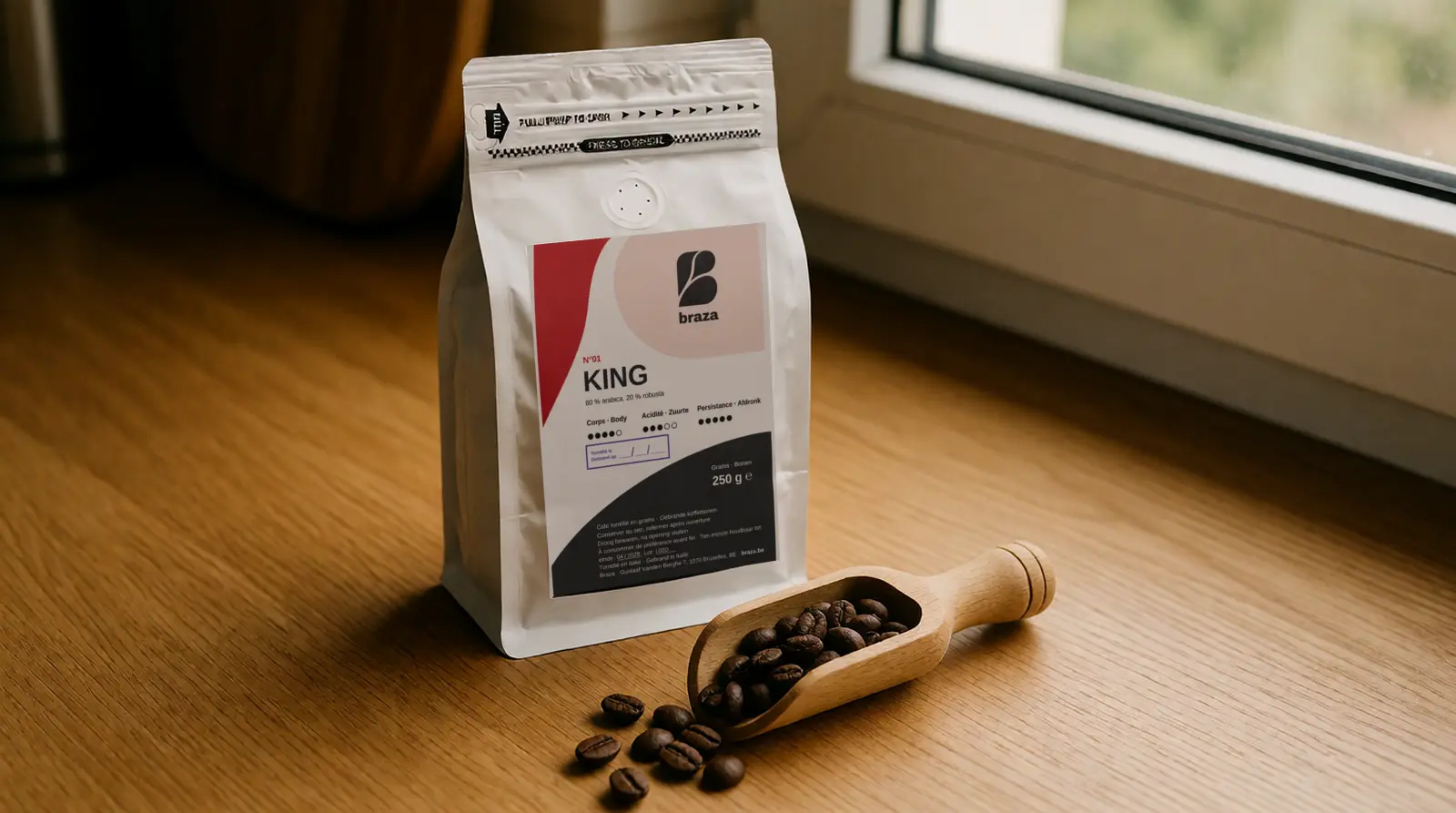
Knowing how to store coffee beans matters: good beans lose their aroma quickly if they are stored badly. The good news: a few simple habits keep them tasting good for longer. Here is what damages coffee, how long it keeps, and how to store it, freeze it and buy it at the right pace.
Why coffee loses its aroma
Roasted coffee contains hundreds of aromatic compounds. Many of them are volatile: they escape into the air or break down on contact with oxygen. Stale coffee is not dangerous, it is just flat. Five enemies speed up the process.
- Oxygen: it oxidises the oils and aromas in coffee. This is the main factor.
- Light: it breaks down aromas, especially in a clear container.
- Heat: it speeds up degassing and the loss of aroma. Coffee kept near the oven or in the sun ages faster.
- Moisture: coffee is dry and easily absorbs water. Moisture damages the aromas and can cause mould.
- Odours: beans pick up nearby smells, such as spices, onion or cleaning products.
There is also carbon dioxide. During roasting, CO2 forms inside the beans. It escapes little by little, mostly during the first weeks: this is degassing. In a sealed bag, this gas replaces part of the air and limits contact with oxygen. Once the bag is open, air gets in and oxidation speeds up. Degassing also explains the foam that rises when you pour hot water over fresh coffee.
How long do coffee beans last?
There is no exact day when coffee goes bad. It loses its aroma little by little. Here are honest guidelines for coffee that is stored well.
- Beans, sealed bag with a valve: almost no air gets in, and the beans age slowly. Count on several weeks, up to about 2 to 3 months after roasting.
- Beans, opened bag: ideally finish them within about one to three weeks. The more air in the container, the faster the aroma fades.
- Ground coffee, opened bag: finish it within about one to two weeks.
- Coffee ground just before brewing: by far the most aromatic.
The date printed on most supermarket packs is a best-before date. It is often far off and does not tell you when the coffee was roasted. After that date, coffee that has stayed dry is still fine to drink, but it has often lost part of its aroma. To judge freshness, what matters is the roast date. On Braza bags, the date shown is precisely the roast date, not an expiry date.
Right after roasting, coffee is still releasing a lot of gas. In espresso, this gas can get in the way of extraction and make the cup uneven. That is why a few days of rest are often recommended before brewing it as espresso. For filter coffee it matters less: the gas escapes while you brew.
Beans or ground: why beans last longer
Grinding coffee greatly increases its surface in contact with the air. A whole bean protects its aroma inside. Once ground, coffee releases its gas and loses its aroma much faster. That is the simplest reason to buy whole beans: you grind at the last moment, just enough for the cup.
The right container
The ideal container is airtight, opaque and only slightly larger than the amount of coffee. The less air inside, the better.
The original bag, if it has a valve and a zip
A good coffee bag is often the best container. The valve lets the gas out of the coffee without letting air in. The zip lets you reseal the bag after each use. Braza bags have a zip and a valve, so you can keep your beans in them to the very end.
The right move: press gently on the bag to push the air out, then close the zip firmly. Put it away in a cupboard.
An airtight, opaque canister
If your bag does not reseal, pour the coffee into an airtight stainless steel or ceramic canister. Choose a small one, to limit the air. Vacuum canisters, with a plunger or a pump, reduce the air inside even more. Avoid clear glass jars: they let light in. And if your bag reseals well, keep using it: a study found that beans moved into a canister lost their aroma faster than beans left in their bag, closed tightly.
Where to keep coffee
A closed cupboard that is cool, dry and dark is the ideal place. A stable room temperature works very well.
- Away from the oven, the hob and the dishwasher.
- Not right above the coffee machine, which gets warm.
- Away from the window and direct sunlight.
- Away from spices, tea and strong-smelling products.
- Away from the sink and cooking steam.
The fridge: a bad idea
The fridge seems logical, since it slows down the ageing of food. For coffee, it adds little: coffee does not keep better there than in the cupboard. The fridge is damp and full of smells, which coffee can absorb. And every time you take the bag out, condensation can form on the cold beans.
For the coffee you drink every day, the cupboard is still the best choice.
The freezer: yes, with the right method
The freezer is useful if you have more coffee than you can drink in a few weeks. Cold slows down the loss of aroma. Freezing has long been debated, but studies show that frozen beans keep their aroma better than beans left at room temperature. The safest approach: freeze and thaw each portion only once.
- Freeze fresh coffee, ideally within a week of receiving it. Freezing coffee that is already stale will not make it better.
- Split it into small portions of one week’s use each, for example 50 to 100 g.
- Put each portion in a freezer bag or a small airtight jar, pressing out as much air as possible. Vacuum sealing is even better.
- Write the date on each portion and place them at the back of the freezer, away from strong-smelling food.
- Take a portion out the evening before and let it reach room temperature without opening it. That way condensation forms on the packaging, not on the beans.
- Once opened, treat the portion like normal coffee, in the cupboard. Never put it back in the freezer.
Well packed, coffee beans keep for several months in the freezer this way. They still lose aroma slowly, but more slowly than in the cupboard.
Buying the right amount
The best storage is not having to store coffee for long. Buy what you drink in a few weeks, and buy often.
To estimate how much you use, count about 7 g of coffee for a single espresso, twice that for a double, and 12 to 15 g per large mug of filter or French press coffee.
- 1 single espresso a day: about 50 g a week. A 250 g bag lasts about 5 weeks.
- 2 single espressos a day, or 1 double: about 100 g a week. A bag lasts about two and a half weeks.
- 2 large mugs of filter coffee a day: about 190 g a week. A bag lasts about 9 days.
- A two-person household, 4 single espressos a day in total: about 200 g a week, so one bag every 8 to 9 days.
If you drink little coffee, open only one bag at a time. The others stay sealed, protected by their valve. And if an opened bag lasts you more than three weeks, freeze part of it in small portions.
Can’t decide between several coffees? The discovery pack contains one 250 g bag each of King, Queen and Ace, whole bean. Open them one after the other: the sealed bags wait their turn, away from the air.
How to tell if your coffee is stale
Stale coffee will not make you ill, but it has little left to offer in the cup. These are the tell-tale signs.
- The smell: when you open the bag, the aroma is weak, flat, sometimes close to cardboard.
- The bloom: in filter brewing, fresh coffee swells and foams when you pour a little hot water. Old coffee barely rises.
- The crema: in espresso, it is thinner, paler and fades quickly.
- The extraction: with the same setting, the espresso runs faster than before.
- The taste: flat, dull, sometimes with notes of cardboard or wood. A rancid note can point to oxidised oils.
If your coffee shows these signs, it is still drinkable. Use it for iced coffee, a dessert or a recipe where it is not the only flavour. And next time, buy a smaller amount.
Frequently asked questions
Can you store coffee beans in a clear glass jar?
It is not a good idea. Glass keeps air out, but it lets light in, and light damages the aroma of coffee. Keep the coffee in its tightly closed bag instead, or in an airtight, opaque canister just a little bigger than your amount of coffee, stored in a cupboard.
Should opened coffee go in the fridge?
No. Coffee does not keep better there than in the cupboard, the fridge is damp and full of smells, and condensation can form every time you take it out. Keep opened coffee in its tightly closed bag or in an airtight canister, in the cupboard.
Are out-of-date coffee beans dangerous?
No, as long as they have stayed dry and show no mould or unusual smell. Old coffee loses its taste, not its safety. However, if the beans have taken on moisture or show white or green spots, throw them away.
Why is my coffee bag puffing up?
It is the CO2 released by the beans after roasting. The valve lets it out without letting air in. A slightly puffed bag shows that the coffee is still degassing: it is recent.
Can you grind coffee in advance?
Yes, but not long in advance. Ground coffee loses its aroma much faster. Keep it in an airtight, opaque container in the cupboard and finish it within one to two weeks. For the best taste, grind just before brewing.