

Whole bean vs ground coffee: what really changes in your cup
Published on 06/11/2026, 8 min read
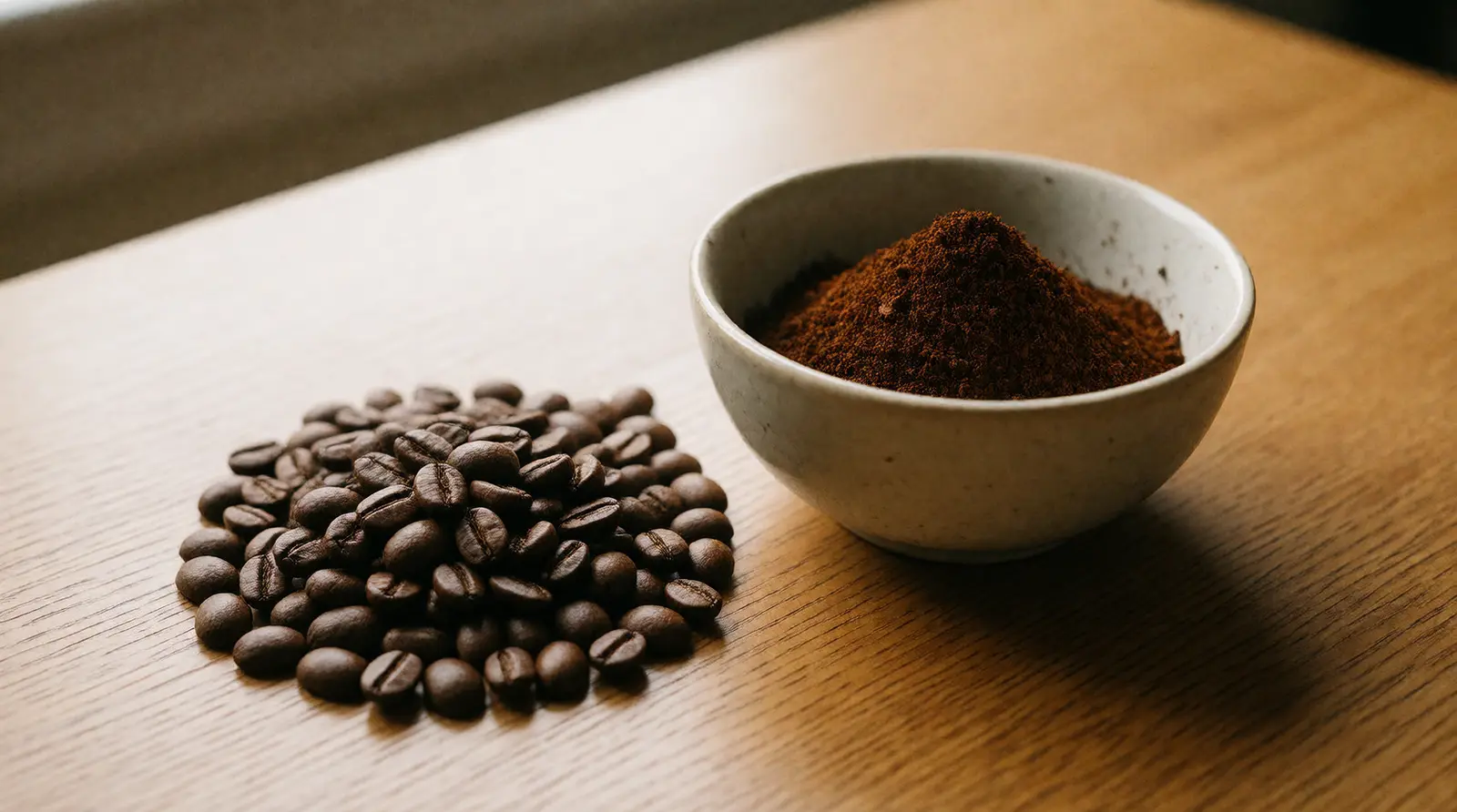
Whole bean vs ground coffee: the real difference comes after grinding. Grinding opens the coffee to the air, and both gas and aromas leave faster. Here is what studies measure, what it changes in your cup, and when pre-ground coffee remains a reasonable choice.
The short answer
If you want taste and aroma, grind your beans just before brewing. If you want simplicity, or have no grinder or no space, good ground coffee is still a defensible choice. In that case, buy a small pack and finish it quickly.
One disclosure: Braza sells whole beans only. So we have an interest in this debate. That is why we stick here to what has been measured, and also say what the studies do not prove.
What physically changes when you grind
Much more exposed surface
A roasted bean is a small porous structure. Once ground, its porosity and exposed surface increase markedly. Research on coffee staling is clear on this point: that is what speeds up degassing and the loss of freshness.
CO2 leaves first
Roasting produces gas, mainly CO2. It makes up about 1% of the weight of freshly roasted coffee and stays trapped in the pores. In a whole bean it escapes slowly, over about a month.
Grinding breaks those pores. A Swiss team measured up to 75% of the gas released during grinding and in the following 90 seconds, on freshly roasted, finely ground coffee. Other measurements give about 26 to 30% for a coarse grind, 33 to 38% for a medium grind and 45 to 59% for a fine grind. The figures vary with the method, but the trend is clear: the finer the grind, the larger the immediate loss.
This CO2 plays a part in espresso crema. But losing gas in seconds does not mean losing all the aromas in seconds. These are two different things.
Volatile aromas escape
Coffee aroma comes mainly from about thirty compounds, many of them fragile. Methanethiol is a good example: highly volatile, reactive and sensitive to oxidation. Whole beans are not immune. In a German study of beans kept in non-airtight packaging, its level fell to about 30% of the starting value after 8 days.
Oxygen and moisture do the rest
Oxygen is described as the most important factor in the shelf life of coffee. Among other things, it oxidises the fats in coffee, which eventually produces unpleasant flavours. Moisture also speeds up the loss of aromas.
What studies measure on ground coffee
An Italian study simulated home use: dark-roast ground coffee kept at 30 °C, in packaging opened and closed regularly. Half of the tasters rejected the coffee after about 20 days, and after about 13 days when the coffee was clearly more humid. That rejection matched a loss of about 60% of volatile compounds.
A Czech study from 2024 tested ground coffee in several types of packaging, opened and closed repeatedly. After 30 days, 35 to 45% of the volatile compounds were lost, and more than 80% in a paper sachet.
Beans age too. In opened packs followed by a Swiss team, methanethiol fell to about 15% of its starting value within eight weeks of storage.
One limit remains. Coffee changes constantly, and the scientific literature admits that these experiments are very hard to control. You will often read that ground coffee goes stale after 15 minutes or an hour. We found no study that sets such a clock for every case. What is established: ground coffee ages faster, and faster still in air, heat and moisture.
Whole bean or ground: the honest comparison
Taste
European consumer organisations write that freshly ground coffee gives the most intense aromas. But we found no large published blind test comparing both formats on the same coffee. A US consumer test also rated some pre-ground coffees as very good. The advantage of beans is real, but it does not replace the quality of the coffee itself.
Freshness
A sealed pack of ground coffee is well protected as long as it stays closed: industrial packaging generally gives a shelf life in the order of 1 to 2 years. Things speed up once it is opened. With beans, you grind at the last moment, every time you brew. That is where beans take the lead.
Convenience
Ground coffee wins here. No grinder, no adjustment, nothing extra to clean. Beans take one more step for every coffee.
Price
We found no rule that holds everywhere for the price per kilo: it depends mainly on the brand and the range. The real extra cost of beans is the grinder or the machine.
Equipment
Ground coffee only needs your coffee maker. Beans need a grinder or a bean-to-cup machine.
A grind that fits your machine
This is the most concrete advantage of beans. A pack of ground coffee holds a single grind, decided before you buy it. With beans, you set the fineness for your method, and you can correct it.
If the coffee is too sour and thin, try slightly finer. If it is too bitter, try slightly coarser. This matters most for espresso: with a standard non-pressurised basket, only the ground coffee slows the water. Our grind guide gives reference points for each method.
When ground coffee is a reasonable choice
There is no shame in buying ground coffee. It makes sense in several cases:
- You do not want a grinder, because of budget or space.
- You prefer a simple morning routine, with no adjustment.
- Your espresso machine has a pressurised basket: it is designed to tolerate pre-ground coffee better.
- You drink enough coffee to finish a pack quickly.
- You only make coffee occasionally, for example when travelling.
Which grinder to start with?
A blade grinder chops the beans. It costs little, but it gives particles of widely varying sizes. The same result is hard to repeat. It can help out, but it is not recommended for a pump espresso machine.
A burr grinder grinds the beans between two surfaces, and the gap between them sets the fineness. The grind is more even, and you get the same setting every day. This is the type to aim for at the start.
For prices, a German consumer test from 2019 gives a reference: blade grinders from 20 euros, a good burr model at 41 euros, the best in the test at 146 euros, and models up to 335 euros. Prices may have changed since. There are also manual burr grinders, at a few dozen euros.
Bean-to-cup machines
A bean-to-cup machine has a built-in grinder: it grinds the beans, then brews the coffee. It is the simplest way to switch to beans, but not the cheapest. A German test recorded about 280 to 630 euros in July 2026 for simple models without a milk system, and a French test advises budgeting at least 300 euros.
These machines take up space and need cleaning, especially with milk. Results also vary from one model to another, even with the same beans. Many let you adjust the grind: do it one step at a time and follow the manual, as a large jump can damage the grinder on some models. Some also accept ground coffee.
Our coffees work in any machine that takes beans: a bean-to-cup machine or an espresso machine with a grinder.
Switching to beans in six steps
- Identify your method: espresso, moka pot, filter or French press.
- Choose your equipment: a burr grinder or a bean-to-cup machine.
- Buy a small quantity to start, while you find your settings.
- Grind only the dose you need, just before making the coffee.
- Start from a setting suited to your method, taste, then adjust in small steps.
- Press the air out of the bag, close the zip firmly and put it in a cupboard.
Our 250 g bags have a zip and a valve, which lets the coffee's gas out without letting air in. To find your coffee, the discovery pack brings together one bag of King, one of Queen and one of Ace.
Frequently asked questions
Does Braza sell ground coffee?
No. Our coffees are sold as whole beans only. Grind them just before brewing.
How long does ground coffee stay good after opening?
There is no single duration. The studies mentioned above show large losses in about 2 to 4 weeks, depending on heat, moisture and packaging.
Can I grind in the evening for the next morning?
Yes, if it makes life easier, in a tightly closed container. You will lose part of the gas and aromas. We found no study that puts a figure on the effect of a single night.
Do whole beans keep indefinitely?
No. Beans also lose freshness, especially after opening. Our storage guide explains how to keep them as well as possible.
Do I need an expensive grinder?
Not necessarily. The 2019 test mentioned above found good models under 50 euros, and bad ones too. For espresso, check that the grinder goes fine enough and adjusts precisely.